Diego Puga's Research
Working Papers
- 'Knowledge creation and control in organizations', with Daniel Trefler
Articles
- 'Urban growth and its aggregate implications', with Gilles Duranton. Econometrica 91(6), November 2023: 2219-2259.
- 'City of dreams', with Jorge De la Roca and Gianmarco I. P. Ottaviano. Journal of the European Economic Association 21(2), April 2023: 690-726.
- 'Calling from the outside: The role of networks in residential mobility', with Konstantin Büchel, Maximilian V. Ehrlich, and Elisabet Viladecans. Journal of Urban Economics 119, September 2020: 103277.
- 'The economics of urban density', with Gilles Duranton. Journal of Economic Perspectives 34(3), Summer 2020: 3-26.
- 'Learning by working in big cities', with Jorge De la Roca. Review of Economic Studies 84(1), January 2017: 106-142.
- 'International trade and institutional change: Medieval Venice's response to globalization', with Daniel Trefler. Quarterly Journal of Economics 129(2), May 2014: 753-821.
- 'The productivity advantages of large cities: Distinguishing agglomeration from firm selection', with Pierre-Philippe Combes, Gilles Duranton, Laurent Gobillon, and Sébastien Roux. Econometrica 80(6), November 2012: 2543-2594.
- 'Ruggedness: The blessing of bad geography in Africa', with Nathan Nunn. Review of Economics and Statistics 94(1), February 2012: 20-36.
- 'The magnitude and causes of agglomeration economies'. Journal of Regional Science 50(1), February 2010: 203-219
- 'Wake up and smell the ginseng: The rise of incremental innovation in low-wage countries', with Daniel Trefler. Journal of Development Economics 91(1), January 2010: 64-76.
- 'Decomposing the growth in residential land in the United States', with Henry G. Overman and Matthew A. Turner. Regional Science and Urban Economics 38(5), September 2008: 487-497.
- 'Fat City: Questioning the relationship between urban sprawl and obesity', with Jean Eid, Henry G. Overman, and Matthew A. Turner. Journal of Urban Economics 63(2), March 2008: 385-404.
- 'Causes of sprawl: A portrait from space', with Marcy Burchfield, Henry G. Overman, and Matthew A. Turner. Quarterly Journal of Economics, 121(2), May 2006: 587-633.
- 'From sectoral to functional urban specialisation', with Gilles Duranton. Journal of Urban Economics 57(2), March 2005: 343-370.
- 'European regional policy in light of recent location theories'. Journal of Economic Geography 2(4), October 2002: 373-406
- 'Unemployment clusters across Europe's regions and countries', with Henry G. Overman. Economic Policy 34, April 2002: 115-147.
- 'Nursery Cities: Urban diversity, process innovation, and the life cycle of products', with Gilles Duranton. American Economic Review 91(5), December 2001: 1454-1477.
- 'Diversity and specialisation in cities: Why, where and when does it matter?', with Gilles Duranton. Urban Studies 37(3), April 2000: 533-555.
- 'Agglomeration and economic development: Import substitution vs. trade liberalisation', with Anthony J. Venables. Economic Journal 109(455), April 1999: 292-311.
- 'The rise and fall of regional inequalities'. European Economic Review 43(2), February 1999: 303-334
- 'Agglomeration in the global economy: A survey of the 'new economic geography'', with Gianmarco I. P. Ottaviano. World Economy 21(6), August 1998: 707-731.
- 'Urbanisation patterns: European vs. less developed countries'. Journal of Regional Science 38(2), May 1998: 231-252.
- 'Trading arrangements and industrial development', with Anthony J. Venables. World Bank Economic Review 12(2), May 1998: 221-249.
- 'Preferential trading arrangements and industrial location', with Anthony J. Venables. Journal of International Economics, 43(3-4), November 1997: 347-368.
- 'The spread of industry: spatial agglomeration in economic development', with Anthony J. Venables. Journal of the Japanese and International Economies, 10(4), December 1996: 440-464.
Book chapters
- 'Urban land use', with Gilles Duranton. In Gilles Duranton, J. Vernon Henderson, and William S. Strange (eds.) Handbook of Regional and Urban Economics, Vol. 5, 2015. Amsterdam: North-Holland, 467-560.
- 'The growth of cities', with Gilles Duranton. In Steven N. Durlauf and Philippe Aghion, (eds.) Handbook of Economic Growth, Vol. 2A, 2014. Amsterdam: North-Holland, 781-853.
- 'Labour pooling as a source of agglomeration: An empirical investigation', with Henry G. Overman. In Agglomeration Economics, Edward L. Glaeser (ed.). Chicago, il: University of Chicago Press, April 2010, 133-150
- 'Micro-foundations of urban agglomeration economies', with Gilles Duranton. In J. Vernon Henderson and Jacques-François Thisse (eds.) Handbook of Regional and Urban Economics, Vol. 4, 2004. Amsterdam: North-Holland, 2063-2117.
Urban growth and its aggregate implications
with Gilles Duranton
Econometrica 91(6), November 2023: 2219-2259.
doi: 10.3982/ECTA17936
Previously distributed as cepr discussion paper 14215, December 2019.
Abstract: We develop an urban growth model where human capital spillovers foster entrepreneurship and learning in heterogeneous cities. Incumbent residents limit city expansion through planning regulations so that commuting and housing costs do not outweigh productivity gains from agglomeration. The model builds on strong microfoundations, matches key regularities at the city and economy-wide levels, and generates novel predictions for which we provide evidence. It can be quantified relying on few parameters and gives us a basis to estimate them. We examine counterfactuals relaxing planning regulations or constraining city growth to assess the effect of cities on economic growth and aggregate output.
The published article is available
for download as a pdf file (899 Kb)
(copyright by the Econometric Society)
The online appendices for this paper are also available for download
The replication files for this paper are available for download from https://diegopuga.org/data/urbangrowth/
City of dreams
with Jorge De la Roca and Gianmarco I. P. Ottaviano
Journal of the European Economic Association 21(2), April 2023: 690-726.
doi: 10.1093/jeea/jvac042
Previously distributed as cemfi working paper 1609, December 2016.
Abstract: Bigger cities offer more valuable experience and opportunities in exchange for higher housing costs. While higher-ability workers benefit more from bigger cities, they are not more likely to move to one. Our model of urban sorting by workers with heterogeneous self-confidence and ability suggests flawed self-assessment is partly to blame. Analysis of nlsy79 data shows that, consistent with our model, young workers with high self-confidence are more likely to locate in a big city initially. For more experienced workers, ability plays a stronger role in determining location choices, but the lasting impact of earlier choices dampens their incentives to move.
The published article is available for download as a pdf file (564 Kb)
An online appendix with additional tables for this paper is also available for download
The replication files for this paper are available for download from https://diegopuga.org/data/dreams/
Calling from the outside: The role of networks in residential mobility
with Konstantin Büchel, Maximilian V. Ehrlich, and Elisabet Viladecans
Journal of Urban Economics 119, September 2020: 103277.
doi: 10.1016/j.jue.2020.103277
Previously distributed as cepr discussion paper 13615, March 2019.
Abstract: Using anonymised cellphone data, we study how social networks shape residential mobility decisions. Individuals with few local contacts are more likely to change residence. Movers strongly prefer neighbourhoods where they already know more people nearby. Contacts matter because proximity to them is valuable and makes attractive locations more enjoyable. They also provide hard-to-find local information and reduce frictions, especially in home-search. Effects are not driven by similar people being more likely to be friends and move between certain locations. Recently-moved and more central contacts are particularly influential. With age, proximity to family gains importance over friends.
The published article is available for download as a pdf file (965 Kb)
The economics of urban density
with Gilles Duranton
Journal of Economic Perspectives 34(3), Summer 2020: 3-26.
doi: 10.1257/jep.34.3.3
Previously distributed as cepr discussion paper 14768, May 2020.
Abstract: Urban density boosts productivity and innovation, improves access to goods and services, reduces typical travel distances, encourages energy-efficient construction and transport, and facilitates sharing scarce amenities. However, density is also synonymous with crowding, makes living and moving in cities more costly, and concentrates exposure to pollution and disease. We explore the appropriate measurement of density and describe how it is both a cause and a consequence of the evolution of cities. We then discuss whether and how policy should target density and why the trade-off between its pros and cons is unhappily resolved by market and political forces.
The published article is available
for download as a pdf file (723 Kb)
(copyright by the American Economic Association)
The replication files for this paper are available for download from https://diegopuga.org/data/density/
Learning by working in big cities
with Jorge De la Roca
Review of Economic Studies 84(1), January 2017: 106-142.
doi: 10.1093/restud/rdw031
Previously distributed as cepr discussion paper 9243, December 2012.
Abstract: Individual earnings are higher in bigger cities. We consider three reasons: spatial sorting of initially more productive workers, static advantages associated with workers' current location, and learning by working in big cities. Using rich administrative data for Spain, we find that workers in bigger cities do not have higher unobserved initial ability, as reflected in individual fixed-effects. Instead, they obtain an immediate static premium while working in bigger cities and also accumulate more valuable experience, which increases their earnings faster. The additional value of experience accumulated in bigger cities persists even after workers move away and is even stronger for those with higher unobserved initial ability. This combination of effects explains both the higher mean and the greater dispersion of earnings in bigger cities.
The published article is available for download as a pdf file (1,232 Kb)
The replication files for this paper are available for download from https://diegopuga.org/data/mcvl/
Urban land use
with Gilles Duranton
In Gilles Duranton, J. Vernon Henderson, and William S. Strange (eds.) Handbook of Regional and Urban Economics, Vol. 5, 2015. Amsterdam: North-Holland, 467-560.
doi: 10.1016/B978-0-444-59517-1.00008-8
Previously distributed as cepr discussion paper 10282, December 2014.
Abstract: We provide an integrated treatment of the theoretical literature on urban land use inspired by the monocentric model, including extensions that deal with multiple endogenous business centres, various dimensions of heterogeneity, and durable housing. After presenting the theory and distilling its key empirical implications, we critically review the empirical literature on differences in prices and development across urban locations, patterns of location choices of heterogeneous households in cities, sprawl and residential decentralization, and employment decentralization.
The most recent working paper version is available for download as a pdf file (1,080 Kb)
International trade and institutional change: Medieval Venice's response to globalization
with Daniel Trefler
Quarterly Journal of Economics 129(2), May 2014: 753-821.
doi: 10.1093/qje/qju006
Previously distributed as cepr discussion paper 9076, July 2012.
Abstract: International trade can have profound effects on domestic institutions. We examine this proposition in the context of medieval Venice circa 800-1600. Early on, the growth of longdistance trade enriched a broad group of merchants who used their newfound economic muscle to push for constraints on the executive i.e., for the end of a de facto hereditary Doge in 1032 and for the establishment of a parliament in 1172. The merchants also pushed for remarkably modern innovations in contracting institutions that facilitated longdistance trade e.g., the colleganza. However, starting in 1297, a small group of particularly wealthy merchants blocked political and economic competition: they made parliamentary participation hereditary and erected barriers to participation in the most lucrative aspects of long-distance trade. Over the next century this led to a fundamental societal shift away from political openness, economic competition and social mobility and towards political closure, extreme inequality and social stratification. We document this 'oligarchization' using a unique database on the names of 8,176 parliamentarians and their families' use of the colleganza in the periods immediately before and after 1297. We then link these families to 6,971 marriage alliances during 1400-1599 in order to document the rise of extreme inequality, with those who were powerful before 1297 emerging as the undisputed economic winners.
The published article is available for download as a pdf file (2,238 Kb)
The data and replication files for this paper are available for download from https://diegopuga.org/data/venice/
The growth of cities
with Gilles Duranton
In Steven N. Durlauf and Philippe Aghion (eds.) Handbook of Economic Growth, Vol. 2A, 2014. Amsterdam: North-Holland, 781-853.
doi: 10.1016/B978-0-444-53540-5.00005-7
Previously distributed as cepr discussion paper 9590, August 2013.
Abstract: Why do cities grow in population, surface area, and income per person? Which cities grow faster and why? To these questions, the urban growth literature has offered a variety of answers. Within an integrated framework, this chapter reviews key theories with implications for urban growth. It then relates these theories to empirical evidence on the main drivers of city growth, drawn primarily from the United States and other developed countries. Consistent with the monocentric city model, fewer roads and restrictions on housing supply hinder urban growth. The fact that housing is durable also has important effects on the evolution of cities. In recent decades, cities with better amenities have grown faster. Agglomeration economies and human capital are also important drivers of city growth. Although more human capital, smaller firms, and a greater diversity in production foster urban growth, the exact channels through which those effects percolate are not clearly identified. Finally, shocks also determine the fate of cities. Structural changes affecting the broader economy have left a big footprint on the urban landscape. Small city-specific shocks also appear to matter, consistent with the recent wave of random growth models.
The most recent working paper version is available for download as a pdf file (475 Kb)
The productivity advantages of large cities: Distinguishing agglomeration from firm selection
with Pierre-Philippe Combes, Gilles Duranton, Laurent Gobillon, and Sébastien Roux
Econometrica 80(6), November 2012: 2543-2594.
doi: 10.3982/ECTA8442
Previously distributed as cepr discussion paper 7191, March 2009.
Abstract: Firms are more productive on average in larger cities. Two main explanations have been offered: firm selection (larger cities toughen competition, allowing only the most productive to survive) and agglomeration economies (larger cities promote interactions that increase productivity), possibly reinforced by localised natural advantage. To distinguish between them, we nest a generalised version of a tactable firm selection model and a standard model of agglomeration. Stronger selection in larger cities left-truncates the productivity distribution whereas stronger agglomeration right-shifts and dilates the distribution. Using this prediction, French establishment-level data, and a new quantile approach, we show that firm selection cannot explain spatial productivity differences. This result holds across sectors, city size thresholds, establishment samples, and area definitions.
The published article is available
for download as a pdf file (2,007 Kb)
(copyright by the Econometric Society)
Supplemental material for this paper is also available for download
The replication files for this paper are available for download from https://diegopuga.org/data/selectagg/
Ruggedness: The blessing of bad geography in Africa
with Nathan Nunn
Review of Economics and Statistics 94(1), February 2012: 20-36
doi: 10.1162/REST_a_00161
Previously distributed as cepr discussion paper 6253, April 2007.
Abstract: We show that geography, through its impact on history, can have important effects on current economic development. The analysis focuses on the historic interaction between ruggedness and Africa's slave trades. Although rugged terrain hinders trade and most productive activities, negatively affecting income globally, within Africa rugged terrain afforded protection to those being raided during the slave trades. Since the slave trades retarded subsequent economic development, within Africa ruggedness has also had a historic indirect positive effect on income. Studying all countries worldwide, we estimate the differential effect of ruggedness on income for Africa. We show that the differential effect of ruggedness is statistically significant and economically meaningful, it is found in Africa only, it cannot be explained by other factors like Africa's unique geographic environment, and it is fully accounted for by the history of the slave trades.
The most recent working paper version is available for download as a pdf file (294 Kb)
The data and replication files for this paper are available for download from https://diegopuga.org/data/rugged/
Labour pooling as a source of agglomeration: An empirical investigation
with Henry G. Overman
In Edward L. Glaeser (ed.) Agglomeration Economics. Chicago, il: University of Chicago Press, April 2010, 133-150.
doi: 10.7208/CHICAGO/9780226297927.003.0005
Previously distributed as cepr discussion paper 7174, February 2009.
Abstract: We provide empirical evidence on the role of labour market pooling in determining the spatial concentration of UK manufacturing establishments. This role arises because large concentrations of employment iron out idiosyncratic shocks and improve establishments' ability to adapt their employment to good and bad times. We measure the likely importance of labour pooling by calculating the fluctuations in employment of individual establishments relative to their sector and averaging by sector. Our results show that sectors whose establishments experience more idiosyncratic volatility are more spatially concentrated, even after controlling for a range of other industry characteristics that include a novel measure of the importance of localized intermediate suppliers.
The published book chapter is available for download as a pdf file (183 Kb)
The magnitude and causes of agglomeration economies
Journal of Regional Science 50(1), February 2010: 203-219
doi: 10.1111/j.1467-9787.2009.00657.x
Previously distributed as imdea working paper 2009-09, September 2009.
Abstract: Firms and workers are much more productive in large and dense urban environments. There is substantial evidence of such agglomeration economies based on three aproaches. First, on a clustering of production beyond what can be explained by chance or comparative advantage. Second, on spatial patterns in wages and rents. Third, on systematic variations in productivity with the urban environment. However, more needs to be learned about the causes of agglomeration economies. We have good models of agglomeration through sharing and matching, but not a deep enough understanding of learning in cities. Despite recent progress, more work is needed to distinguish empirically between alternative causes.
The most recent working paper version is available for download as a pdf file (247 Kb)
Wake up and smell the ginseng: International trade and the rise of incremental innovation in low-wage countries
with Daniel Trefler
Journal of Development Economics 91(1), January 2010: 64-76
doi: 10.1016/j.jdeveco.2009.01.011
Previously distributed as cepr discussion paper 5286, October 2005.
Abstract: Increasingly, a small number of low-wage countries such as China and India are involved in incremental innovation. That is, they are responsible for resolving production-line bugs and suggesting product improvements. We provide evidence of this new phenomenon and develop a model in which there is a transition from old-style product-cycle trade to trade involving incremental innovation in low-wage countries. The model explains why levels of involvement in incremental innovation vary across low-wage countries and across firms within each low-wage country. We draw out implications for sectoral earnings, living standards, the capital account and, foremost, international trade in goods.
The most recent working paper version is available for download as a pdf file (495 Kb)
Decomposing the growth in residential land in the United States
with Henry G. Overman and Matthew A. Turner
Regional Science and Urban Economics 38(5), September 2008: 487-497
doi: 10.1016/j.regsciurbeco.2008.05.006
Previously distributed as cepr discussion paper 6190, March 2007.
Abstract: This paper decomposes the growth in land occupied by residences in the United States to give the relative contributions of changing demographics versus changes in residential land per household. Between 1976 and 1992 the amount of residential land in the United States grew 47.7% while population only grew 17.8%. At first glance, this suggest an important role for per-household increases. However, the calculations in this paper show that only 24.5% of the growth in residential land area can be attributed to state-level changes in land per household. 37.3% is due to overall population growth, 22.6% to an increase in the number of households over this period, 6% to the shift of population towards states with larger houses, and the remaining 9.6% to interactions between these changes. There are large differences across states and metropolitan areas in the relative importance of these components.
The most recent working paper version is available for download as a pdf file (272 Kb)
The data and replication files for this paper are available for download from https://diegopuga.org/data/landpop/
Fat City: Questioning the relationship between urban sprawl and obesity
with Jean Eid, Henry G. Overman, and Matthew A. Turner
Journal of Urban Economics 63(2), March 2008: 385-404
doi: 10.1016/j.jue.2007.12.002
Previously distributed as cepr discussion paper 6191, March 2007.
Abstract: We study the relationship between urban sprawl and obesity. Using data that tracks individuals over time, we find no evidence that urban sprawl causes obesity. We show that previous findings of a positive relationship most likely reflect a failure to properly control for the fact the individuals who are more likely to be obese choose to live in more sprawling neighborhoods. Our results indicate that current interest in changing the built environment to counter the rise in obesity is misguided.
The most recent working paper version is available for download as a pdf file (318 Kb)
Causes of sprawl: A portrait from space
with Marcy Burchfield, Henry G. Overman, and Matthew A. Turner
Quarterly Journal of Economics 121(2), May 2006: 587-633
doi: 10.1162/qjec.2006.121.2.587
Abstract: We study the extent to which us urban development is sprawling and consider what determines differences in sprawl across space. Using remote-sensing data to track the evolution of land use on a grid of 8.7 billion 30x30 metre cells, we measure sprawl as the amount of undeveloped land surrounding an average urban dwelling. On this measure, while the extent of sprawl remained roughly unchanged between 1976 and 1992, it varied dramatically across metropolitan areas. Ground water availability, temperate climate, rugged terrain, decentralized employment, early public transport infrastructure, uncertainty about metropolitan growth, and unincorporated land in the urban fringe all increase sprawl.
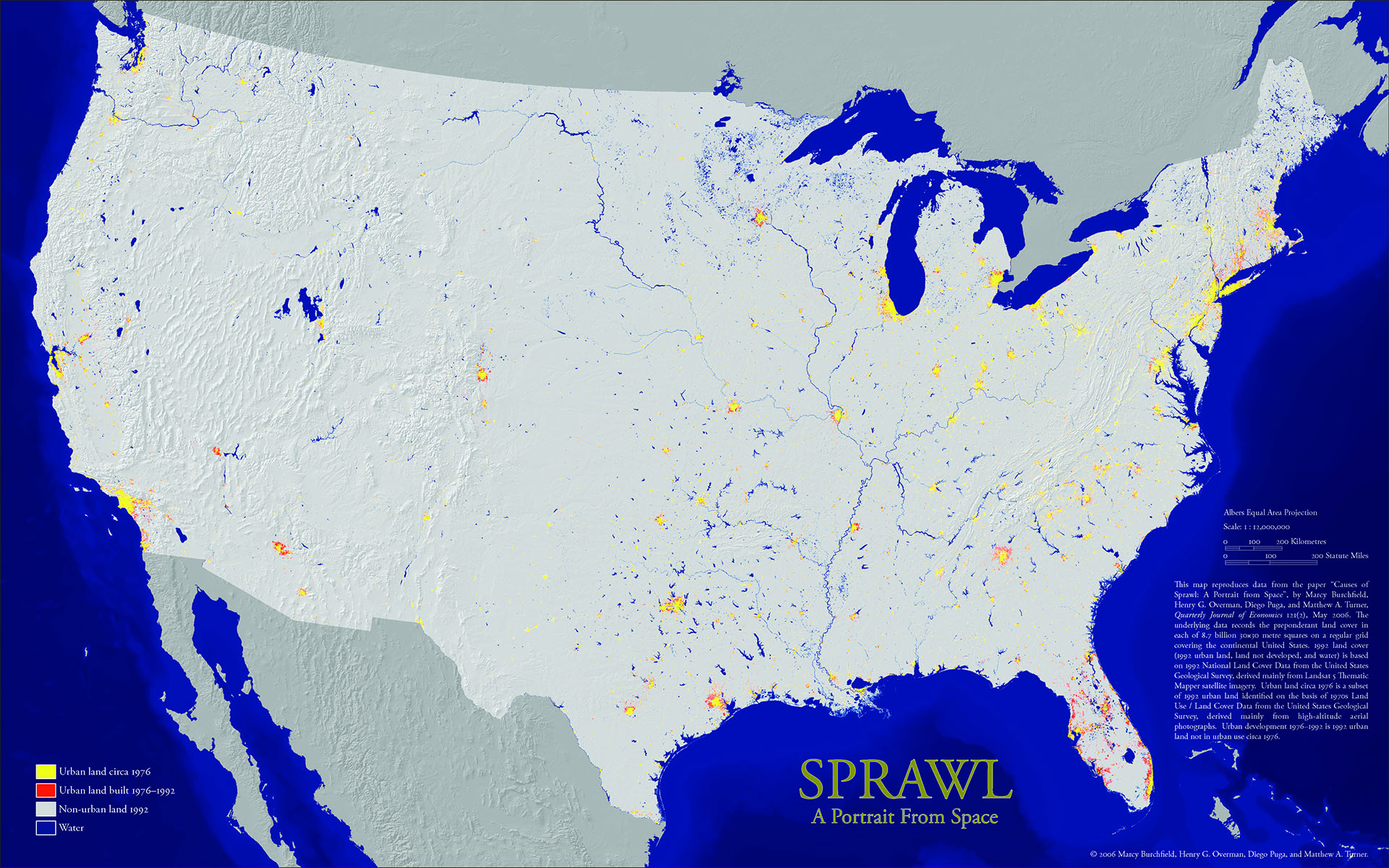 |
A poster (11x17in) with a map showing urban development across the continental United States 1976-1992, based on data from this paper, is available as a pdf file (4,276 Kb) by clicking on the image to the left of this text. |
The published article is available
for download as a pdf file (2,901 Kb)
(copyright by the President and Fellows of Harvard College)
The data and replication files for this paper are available for download from https://diegopuga.org/data/sprawl/
From sectoral to functional urban specialisation
with Gilles Duranton
Journal of Urban Economics 57(2), March 2005: 343-370
doi: 10.1016/j.jue.2004.12.002
Previously distributed as cepr discussion paper 2971, September 2001.
Abstract: Striking evidence is presented of a previously unremarked transformation of urban structure from mainly sectoral to mainly functional specialisation. We offer an explanation showing that this transformation is inextricably interrelated with changes in firms' organisation. A greater variety of business services for headquarters and of sector-specific intermediates for production plants within a city reduces costs, while congestion increases with city size. A fall in the costs of remote management leads to a transformation of the equilibrium urban and industrial structure. Cities shift from specialising by sector -- with integrated headquarters and plants -- to specialising mainly by function -- with headquarters and business services clustered in larger cities, and plants clustered in smaller cities.
The most recent working paper version is available for download as a pdf file (391 Kb)
Knowledge creation and control in organizations
with Daniel Trefler
Revised, March 2014.
Abstract: The incremental innovations that underly much of modern economic growth typically involve changes to one or more components of a complex product. This creates a tension. On the one hand, a principal would like an agent to contribute innovative components. On the other hand, ironing out incompatibilities between interdependent components can be a drain on the principal's energies. The principal can conserve her energies by tightly controlling the innovation process, but this may inadvertently stifle the agent's incentive to innovate. We show precisely how this tension between creating knowledge and controlling knowledge shapes organizational forms. The novel concepts introduced are illustrated with case studies of the flat panel cathode ray tube industry and Boeing's location decisions.
The most recent working paper version is available for download as a pdf file (335 Kb)
Micro-foundations of urban agglomeration economies
with Gilles Duranton
In J. Vernon Henderson and Jacques-François Thisse (eds.) Handbook of Regional and Urban Economics, Vol. 4, 2004. Amsterdam: North-Holland, 2063-2117.
doi: 10.1016/S1574-0080(04)80005-1
Previously distributed as cepr discussion paper 4062, September 2003.
Abstract: This handbook chapter studies the theoretical micro-foundations of urban agglomeration economies. We distinguish three types of micro-foundations, based on sharing, matching, and learning mechanisms. For each of these three categories, we develop one or more core models in detail and discuss the literature in relation to those models. This allows us to give a precise characterisation of some of the main theoretical underpinnings of urban agglomeration economies, to discuss modelling issues that arise when working with these tools, and to compare different sources of agglomeration economies in terms of the aggregate urban outcomes they produce as well as in terms of their normative implications.
The most recent working paper version is available for download as a pdf file (620 Kb)
European regional policy in light of recent location theories
Journal of Economic Geography 2(4), October 2002: 373-406
doi: 10.1093/jeg/2.4.373
Previously distributed as cepr discussion paper 2767, April 2001.
Abstract: Despite large regional policy expenditures, regional inequalities in Europe have not narrowed substantially over the last two decades, and by some measures have even widened. Income differences across States have fallen, but inequalities between regions within each State have risen. European States have developed increasingly different production structures. And European regions have also become increasingly polarised in terms of their unemployment rates. This paper describes these trends, and discusses how recent location theories can help us to explain them and reconsider the role of regional policies, and specially of transport infrastructure improvements, in such an environment.
The most recent working paper version is available for download as a pdf file (1,406 Kb)
Unemployment clusters across Europe's regions and countries
with Henry G. Overman
Economic Policy 34, April 2002: 115-147
doi: 10.1111/1468-0327.00085
Previously distributed as cepr discussion paper 2255, October 1999.
Abstract: High unemployment and regional inequalities are major concerns for European policy-makers, but so far connections between policies dealing with unemployment and regional inequalities have been few and weak. We think that this should change. This paper documents a regional and transnational dimension to unemployment -- i.e., geographical unemployment clusters that do not respect national boundaries. Since the mid 1980s, regions with high or low initial unemployment rates saw little change, while regions with intermediate unemployment moved towards extreme values. During this polarization, nearby regions tended to share similar outcomes due, we argue, to spatially related changes in labour demand. These spatially correlated demand shifts were due in part to initial clustering of low-skilled regions and badly performing industries, but a significant neighbour effect remains even after controlling for these, and the effect is as strong within as it is between nations. We believe this reflects agglomeration effects of economic integration. The new economic geography literature shows how integration fosters employment clusters that need not respect national borders. If regional labour forces do not adjust, regional unemployment polarization with neighbour effects can result. To account for these 'neighbour effects' a cross-regional and transnational dimension should be added to national anti-unemployment policies. Nations should consider policies that encourage regional wage setting, and short distance mobility, and the eu should consider including transnational considerations in its regional policy, since neighbour effects on unemployment mean that an anti-unemployment policy paid for by one region will benefit neighbouring regions. Since local politicians gain no votes or tax revenues from these 'spillovers', they are likely to underestimate the true benefit of the policy and thus tend to undertake too little of it.
The most recent working paper version is available for download as a pdf file
The European regional unemployment dataset developed for this paper is available for download from https://diegopuga.org/data/uclusters/
Nursery Cities: Urban diversity, process innovation, and the life cycle of products
with Gilles Duranton
American Economic Review 91(5), December 2001: 1454-1477
doi: 10.1257/aer.91.5.1454
Previously distributed as cepr discussion paper 2376, February 2000.
Abstract: This paper develops microfoundations for the role that diversified cities play in fostering innovation. A simple model of process innovation is proposed, where firms learn about their ideal production process by making prototypes. We build around this a dynamic general-equilibrium model, and derive conditions under which diversified and specialised cities coexist. New products are developed in diversified cities, trying processes borrowed from different activities. On finding their ideal process, firms switch to mass production and relocate to specialised cities where production costs are lower. We find strong evidence of this pattern in establishment relocations across French employment areas 1993-1996.
The published article is available
for download as a pdf file (244 Kb)
(copyright by the American Economic Association)
Diversity and specialisation in cities: Why, where and when does it matter?
with Gilles Duranton
Urban Studies 37(3), April 2000: 533-555
doi: 10.1080/0042098002104
Previously distributed as cepr discussion paper 2256, October 1999.
Abstract: Why are some cities specialised and others diversified? What are the advantages and disadvantages of urban specialisation and diversity? To what extent does the structure of cities, and the activities of firms and people in them, change over time? How does the sectoral composition of cities influence their evolution? To answer these and related questions, we first distil some key stylised facts from the empirical literature on cities and the composition of their activities. We then turn to a review of different theories looking at such issues, and study the extent to which these theories contribute to the understanding of the empirical regularities.
The most recent working paper version is available for download as a pdf file (324 Kb)
Agglomeration and economic development: Import substitution vs. trade liberalisation
with Anthony J. Venables
Economic Journal 109(455), April 1999: 292-311
doi: 10.1111/1468-0297.00433
Previously distributed as cepr discussion paper 1782, January 1998.
Abstract: This paper analyses a model of economic development in which international inequalities in the location of industry and income are supported by the agglomeration of industry in a subset of countries. Economic development may not be a gradual process of convergence by all countries, but instead involve countries moving sequentially from the group of poor countries to the group of rich countries. The role of trade policy in promoting industrialisation is studied. While both import substitution and unilateral trade liberalisation may be 'successful' in attracting industry, they attract different sectors and welfare levels are higher under trade liberalisation.
The most recent working paper version is available for download as a pdf file (253 Kb)
The rise and fall of regional inequalities
European Economic Review 43(2), February 1999: 303-334.
doi: 10.1016/S0014-2921(98)00061-0
Previously distributed as cepr discussion paper 1357, February 1997.
Abstract: This paper studies the relationship between the degree of regional integration and regional differences in production structures and income levels. For high transport costs, industry is spread across regions to meet final consumer demand. For intermediate transport costs, increasing returns interacting with migration and/or input-output linkages between firms create a tendency for the agglomeration of increasing returns activities. When workers migrate towards locations with more firms and higher real wages, this intensifies agglomeration. When instead workers do not move across regions, at low transport costs firms become increasingly sensitive to cost differentials, leading industry to spread out again.
The most recent working paper version is available for download as a pdf file (279 Kb)
Agglomeration in the global economy: A survey of the 'new economic geography'
with Gianmarco I. P. Ottaviano
World Economy 21(6), August 1998: 707-731.
doi: 10.1111/1467-9701.00160
Previously distributed as cepr discussion paper 1699, October 1997.
Abstract: This review of recent contributions reveals common conclusions about the effects of integration on location. For high trade costs, the need to supply markets locally encourages firms to spread across different regions. Integration weakens the incentives for self-sufficiency and for intermediate values of trade costs pecuniary externalities induce firms and workers to cluster together, turning location into a self-reinforcing process. However, agglomeration raises the price of immobile local factors and goods, so for low transport costs firms may spread to regions where those prices are lower.
The most recent working paper version is available for download as a pdf file (195 Kb)
Trading arrangements and industrial development
with Anthony J. Venables
World Bank Economic Review 12(2), May 1998: 221-249.
Previously distributed as cep discussion paper 319, December 1996.
Written for the International Trade Division of the World Bank.
Abstract: This paper outlines a new approach for analysing the role of trade in promoting industrial development. It offers an explanation as to why firms are reluctant to move to economies with lower labour costs, and shows how trade liberalisation can change the incentives for firms to locate in developing countries. Unilaterally liberalising imports of manufactures can promote industrialisation, but membership of a preferential trading arrangement is likely to create larger gains. South-South ptas will be sensitive to the market size of member states, while North-South ptas seem to offer better prospects for participating Southern economies, if not for excluded countries.
The most recent working paper version is available for download as a pdf file (288 Kb)
Urbanisation patterns: European vs. less developed countries
Journal of Regional Science 38(2), May 1998: 231-252.
doi: 10.1111/1467-9787.00090
Previously distributed as cep discussion paper 305, September 1996.
Abstract: This paper develops a model in which the interaction between transport costs, increasing returns to scale, and labour migration across sectors and regions creates a tendency for urban agglomeration. Demand from rural areas favours urban dispersion. European urbanisation took place mainly in the XIX century, with higher costs of spatial interaction, weaker economies of scale, and a more elastic supply of labour to the urban sector than in ldcs today. These factors could help explain why primate cities dominate in ldcs, while a comparatively small share of urban population lives in Europe's largest cities.
The most recent working paper version is available for download as a pdf file (203 Kb)
Preferential trading arrangements and industrial location
with Anthony J. Venables
Journal of International Economics 43(3-4), November 1997: 347-368.
doi: 10.1016/S0022-1996(96)01480-8
Previously distributed as cepr discussion paper 1309, December 1995.
Abstract: This paper considers the location effects of geographically discriminatory trade policy. A preferential move towards a free trade area pulls industry into the integrating countries. Input-output links between imperfectly competitive firms amplify this effect and, when trade barriers fall below some critical level, may lead to agglomeration with some member countries gaining industry at the expense of others. A hub-and- spoke arrangement favours location in the hub, with better reciprocal access to spoke nations than these have to each other. Further liberalisation induces agglomeration in the hub and may trigger disparities between the spokes.
Here are animated diagrams showing the effects of
the formation of a customs union| a hub-and-spoke trading arrangement
The most recent working paper version is available for download as a pdf file (185 Kb)
The spread of industry: spatial agglomeration in economic development
with Anthony J. Venables
Journal of the Japanese and International Economies 10(4), December 1996: 440-464.
doi: 10.1006/jjie.1996.0025
Previously distributed as cepr discussion paper 1354, February 1996.
Abstract: This paper describes the spread of industry from country to country as a region grows. All industrial sectors are initially agglomerated in one country, tied together by input-output links between firms. Growth expands industry more than other sectors, bidding up wages in the country in which industry is clustered. At some point firms start to move away, and when a critical mass is reached industry expands in another country, raising wages there. We establish the circumstances in which industry spills over, which sectors move out first, and which are more important in triggering a critical mass.
The most recent working paper version is available for download as a pdf file (200 Kb)